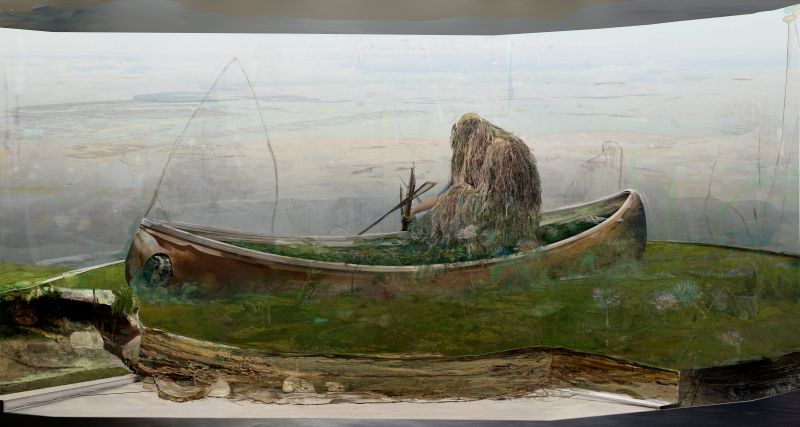
DescriptionLike much of my work, Straw Man utilizes the ambiguity between figuration and abstraction to accommodate a variety of interpretations. However, as a personal project I aimed to express a reflection on the time and context of our contemporary world. In the depicted scene there sits a still and pensive straw person molded to their canoe, only one hand remains unearthed as the rest of the landscape has been layered and grown over. The straw man is a representation of artist Valerie Blass’ sculpture by the same name. Through its appropriation it was as a consequence stripped of much of its original meaning yet it fulfills its role as a character lacking and perhaps compensating for desired qualities.
Through the several layers of simulation in our everyday lives a desired quality and intrinsic relationship with our environment may not be satisfied. This qualitative assessment is difficult to pin down but can be addressed by considering the cognitive and social effect of these environmental changes. We have long since crossed the threshold of nature as culture. As urbanity became the nature of the modernists the digital has become the nature of many contemporary people. Today we spend much of our time interacting with the world through the lenses of our technology, the result of which has been to learn through simulation. With a sense of pride and social responsibility one protects whatever system for living one has adopted.
As a culture we have unwittingly changed our environments to the degree that no common citizen leads an environmentally sustainable life. I feel a particular responsibility as an artist to raise issue with how human interventions continue to alter the environment. The information age is indeed changing the global landscape for better and worse and because of this context I began this piece by collaging together a multitude of images that would bring to light the bearing of the Great Pacific Garbage Patch. These painted and stretched out layers mimic the visual effects of the landscape’s floating debris. The accumulation of these digital layers into the foreground culminated in a sedimentary proscenium arch and center subject. This stage-like appearance is to call attention to the museological settings customary to environmental and sociological investigation and suggests that the work may be considered as an evidential display of a contemporary state of mind.
Straw Man’s enduring role may be to serve in the tradition of art history. It provides a reminder of our mortality but also an argument for having agency in the world. It is a place where contemplation can shift between the lasting effects of humanity and the individual’s relationship to the greater world.
Produced as a triptich and hung with a custom 3 panel frosted acrylic frame.ProvenanceInscription